Correspondence.
The Department for Culture, Media and Sport were asked about safeguarding in publicly funded arts organisations. This is what they replied.

Between July and November 2025 four letters were sent to the Department for Culture, Media and Sport about safeguarding within publicly funded arts organisations. They were addressed to the Secretary of State, the Rt Hon Lisa Nandy MP, and the Minister for Creative Industries, Media and Arts, the Rt Hon Ian Murray MP.
The first letter, on 28 July, concerned the late theatre director Chris Goode and his company, Chris Goode & Company — both of which had received public funding for years before Goode’s death in 2021, and against whom detailed accounts of harm have since been published, in named voice, by people who say they were harmed. I asked the Department two questions. First: what mechanism existed within the funding system to prevent something like this from happening again. Second: would the Department mandate that all publicly funded arts organisations publish their safeguarding policies.
This article reproduces, in full, the correspondence I received in reply. I include it not because the content is extraordinary, but because the act of placing it in one place — together, in date order, in its own words — discloses a position that no single letter does on its own.
The acknowledgement
My first letter went unanswered through the whole of August. On the 24th of that month I wrote again. Four days later, this acknowledgement arrived.
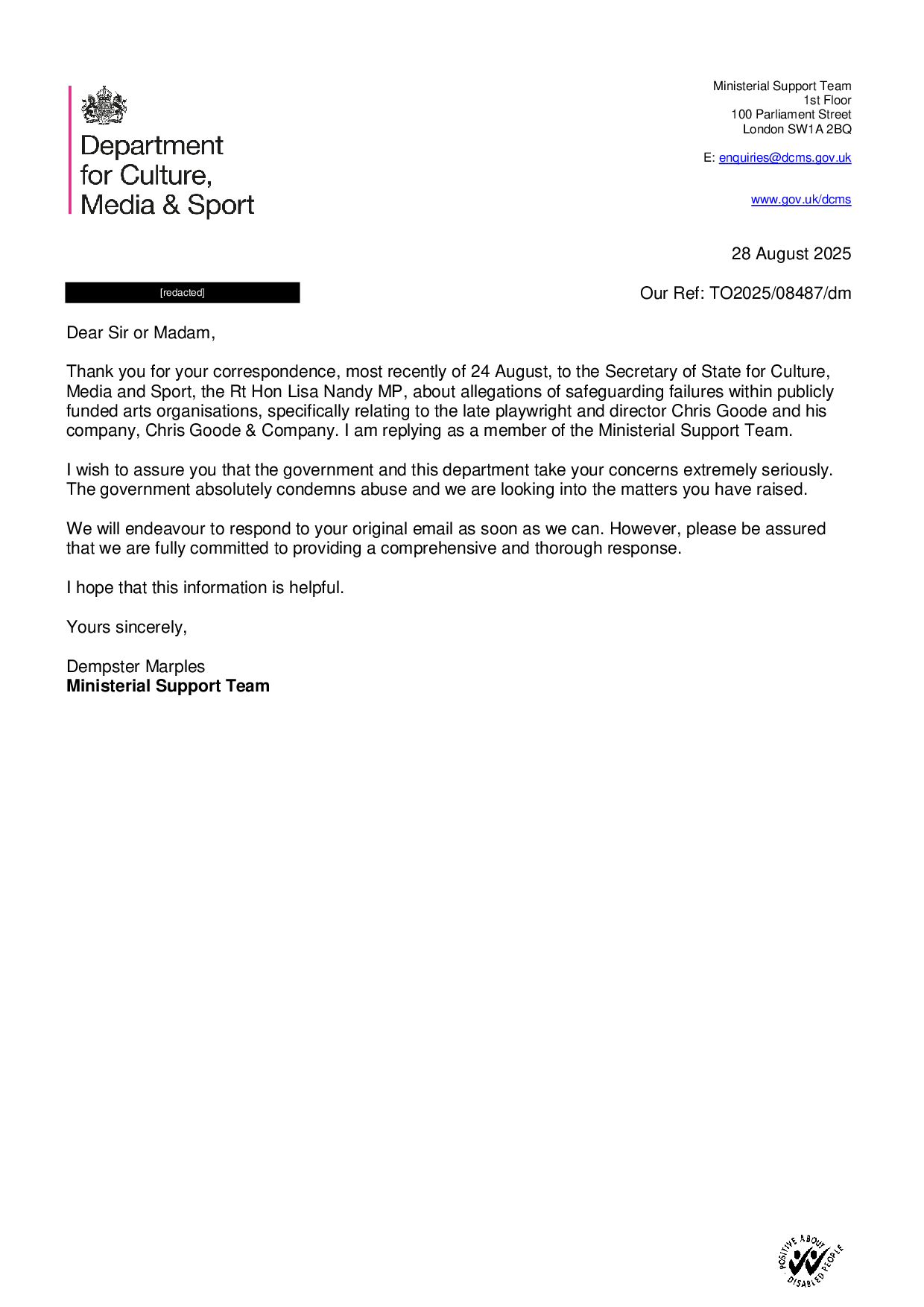
Two things to note. First, the Department’s own framing of what I had written about — returned to me on official paper — is “allegations of safeguarding failures within publicly funded arts organisations, specifically relating to the late playwright and director Chris Goode and his company, Chris Goode & Company.” Those are the government’s words for the subject matter of this article, not mine. Second, the promise: a comprehensive and thorough response, to follow.
The Minister’s reply
The substantive response came on 22 October, eighty-six days after my original letter. It was signed personally by the Minister with the arts brief, the Rt Hon Ian Murray MP.
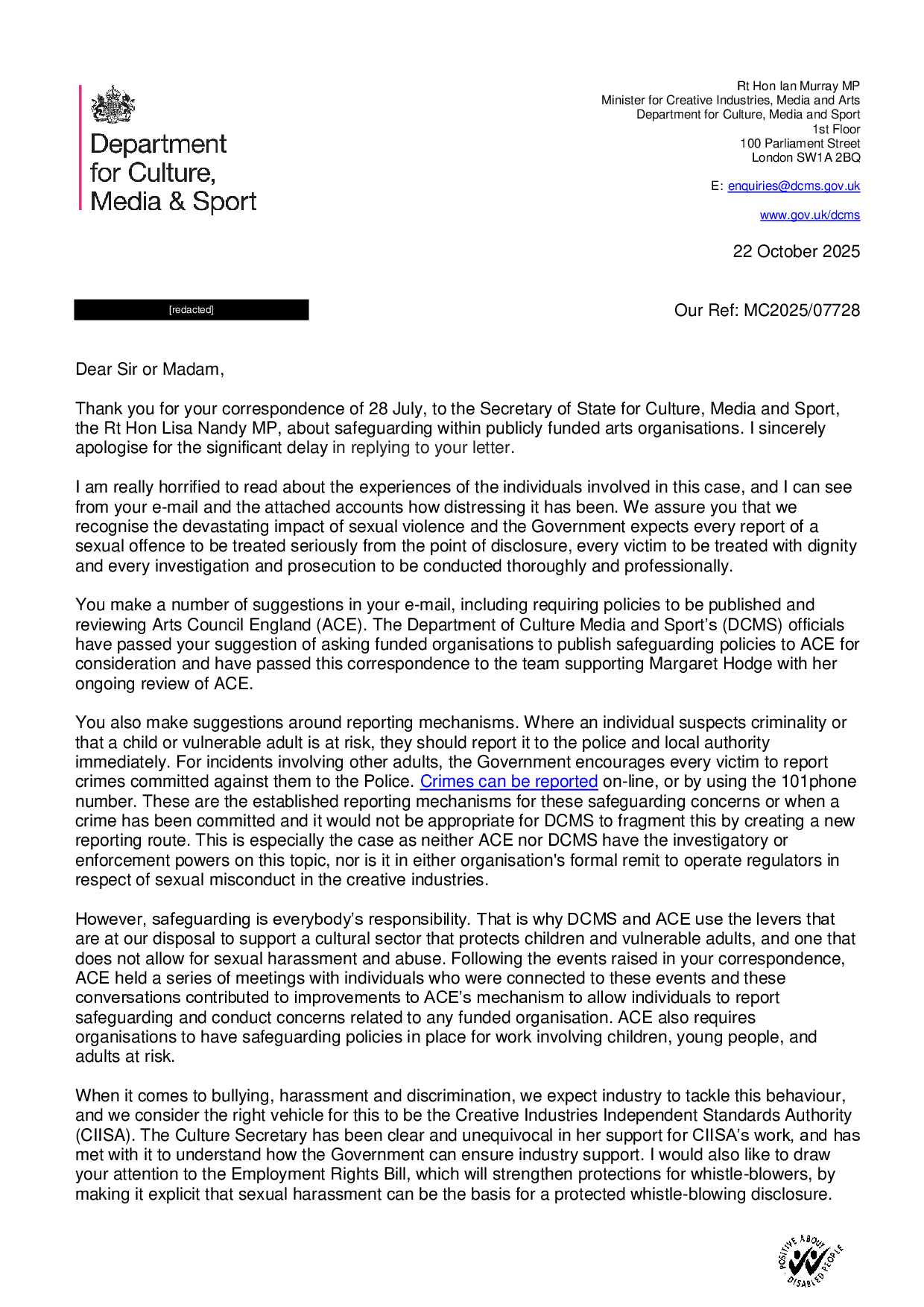


Three passages from this letter are worth attending to closely.
The first is the Minister’s answer to my second question. He writes:
DCMS officials have passed your suggestion of asking funded organisations to publish safeguarding policies to ACE for consideration.
This is neither a refusal nor an acceptance. The Minister has not declined to mandate the publication of safeguarding policies. He has passed the suggestion to the organisation that would be required to do the mandating. The recipient of the suggestion and the body whose conduct it would govern are, in this case, the same.
The second passage concerns where reports of safeguarding failure should go. The Minister writes:
These are the established reporting mechanisms… it would not be appropriate for DCMS to fragment this by creating a new reporting route.
In the context of suspected crime this is the correct answer. I had not asked the government to set up a parallel police force. I had asked whether the funding system itself contained a mechanism for protecting people in advance of the harm — of the kind that does not necessarily produce a crime report. The Minister’s letter answers a question I did not ask.
The third is the passage I find hardest to summarise without quoting:
Neither ACE nor DCMS have the investigatory or enforcement powers on this topic, nor is it in either organisation’s formal remit to operate regulators in respect of sexual misconduct in the creative industries.
The Minister responsible for the arts is confirming, on his own departmental letterhead, that the body that distributes the public money does not have, and is not intended to have, the power to enforce the safeguarding conditions it attaches to that money; and that no other body in the architecture has that remit either. He gestures, in the next paragraph, to the Creative Industries Independent Standards Authority. CIISA is at the time of writing an industry-funded body without statutory powers — that is, a body whose authority where it exists at all rests on the willingness of the industry it is meant to hold to account to comply. He gestures, separately, to the Employment Rights Bill, which extends whistleblower protections inside an employment relationship. None of these is a regulator. Nothing in the present architecture is.
The review acknowledges
Five days after the Minister’s letter, this email arrived from the team to which my correspondence had reportedly been forwarded.
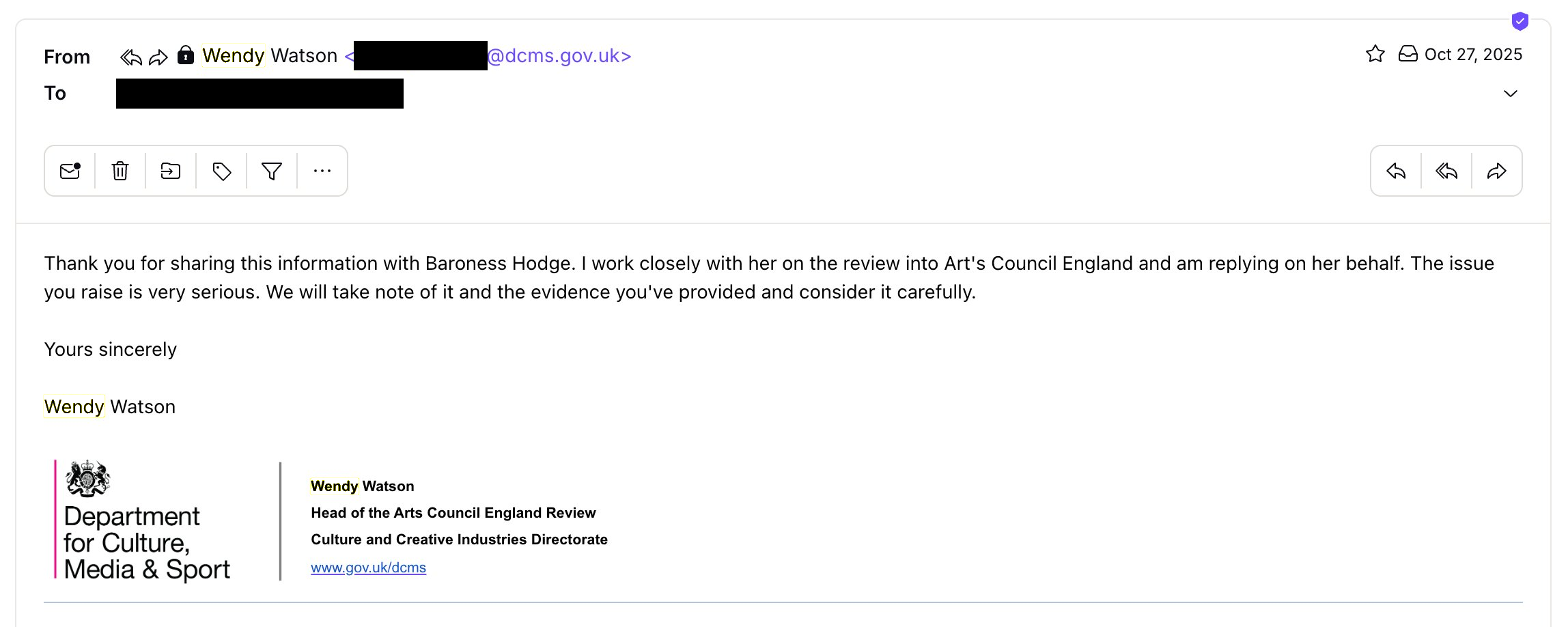
The handoff Murray had described was, on this evidence, a real procedural step rather than a rhetorical one. The email confirms receipt of the evidence and promises careful consideration. What it does not say — and could not, at the level of a procedural acknowledgement — is what the review is empowered to do with the evidence once it has considered it. The Murray letter’s larger admission still stands: neither ACE nor the Department has investigatory or enforcement powers in respect of the conduct the evidence concerns. The review can take the evidence into careful consideration. It cannot, on the Department’s own confirmation, act on it as a regulator.
The policy reply
A month later, the substantive answer to my second question arrived — not from the Minister this time, but from the same member of the Ministerial Support Team who had sent the August acknowledgement. It is the considered reply to the wider policy ask: should organisations that receive public funding be required to publish their safeguarding policies.
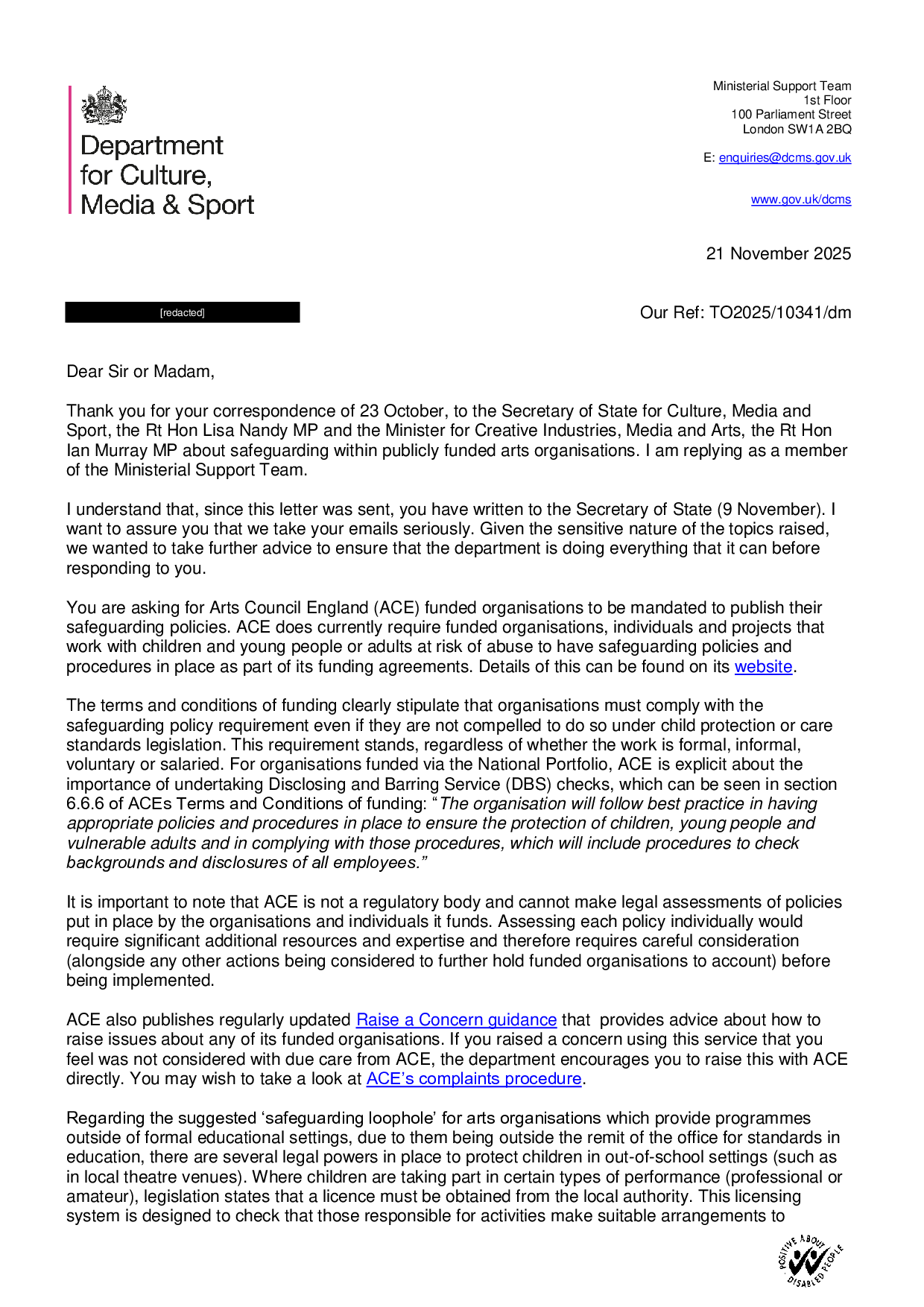
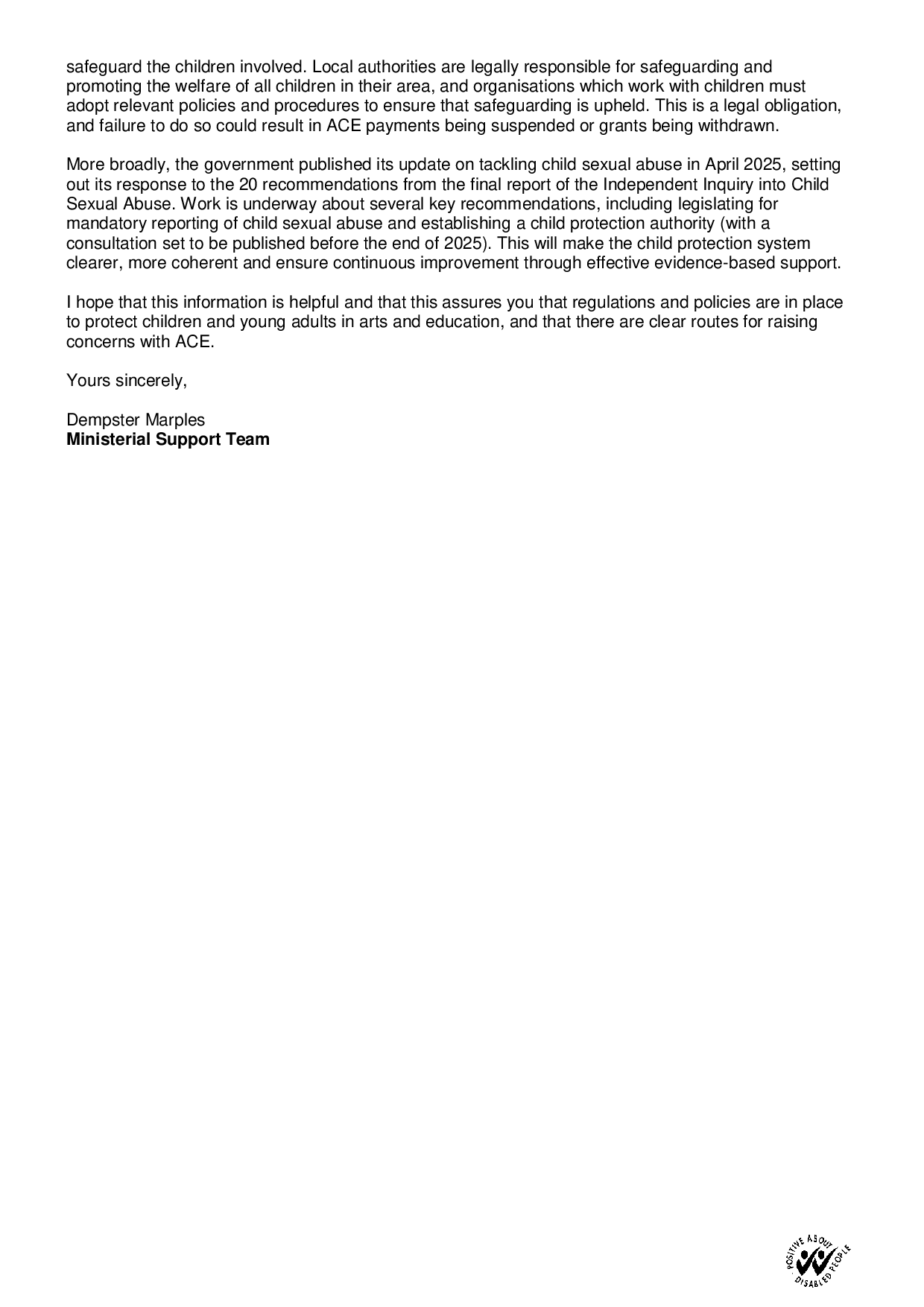
The reply confirms that Arts Council England already requires its funded organisations to have safeguarding policies, quoting section 6.6.6 of ACE’s terms and conditions of funding. The reply states that this requirement applies “regardless of whether the work is formal, informal, voluntary or salaried.” And then it says:
ACE is not a regulatory body and cannot make legal assessments of policies put in place by the organisations and individuals it funds. Assessing each policy individually would require significant additional resources and expertise and therefore requires careful consideration.
That is the answer. Funded organisations are required to have policies; the funder is not equipped to evaluate the policies. Whether a particular organisation’s safeguarding documents describe a robust system, a paper-thin one, or no real system at all, is in the first instance a matter for the applicant’s own honesty in their representations to the funder.
The reasoning offered for not changing this — that doing the assessment would require “significant additional resources and expertise” — is true. It would. The question I would put back to the Department is whether that is, in itself, a reason not to do it.
What is on the record
Stated plainly, the correspondence above confirms the following.
The government, on its own letterhead, condemns abuse and takes safeguarding failures in the publicly funded arts seriously. The Minister with the relevant brief is horrified by what he has read in the accounts that were sent to him. Suggestions about how to improve the funding system’s safeguarding architecture have been formally passed to the body whose architecture they concern. That body — Arts Council England — requires its funded organisations to have safeguarding policies as a condition of funding. It does not, however, have the power to assess whether those policies are adequate. Neither it nor the Department has investigatory or enforcement powers in respect of sexual misconduct in the creative industries, and the function of regulator is not, in the present architecture, a function that anybody performs.
I do not believe the officials who wrote these letters were dishonest. I think they wrote what they were instructed to write, that the briefings they were working from accurately reflect the current architecture, and that the current architecture is precisely the architecture that produces, and has produced, the kind of cases I wrote in about.
A funding system that requires safeguarding policies but cannot assess them is a funding system that, in practice, requires only that funded organisations claim to have policies. A funding system whose oversight body has no investigatory or enforcement powers is, in practice, not a regulated funding system. A funding regime that responds to allegations of safeguarding failure by directing the complainant to a non-statutory industry body, to its own internal complaints procedure, and to the police — none of which is positioned to enforce the terms of the funding agreement — is a regime that has decided this is a problem for somewhere else.
The position of Spoken Record is that public funding for the arts in Britain is not a right of the organisations that receive it. The conditions attached to that funding, including the safeguarding obligations the Department’s own correspondence describes, should be enforced as binding terms by a body with the staff, the budget, and the statutory authority to enforce them. These letters confirm that no such body presently exists. That, in my view, is what needs to change.
If you are affected by the issues raised in this article: support is available 24 hours a day. Call Rape Crisis on 0808 500 2222, or visit rapecrisis.org.uk, nhs.uk, or your local victim and witness information service. If you have correspondence of your own that you believe belongs alongside what is here, write to privacy@spokenrecord.com. Correspondence is treated as confidential.